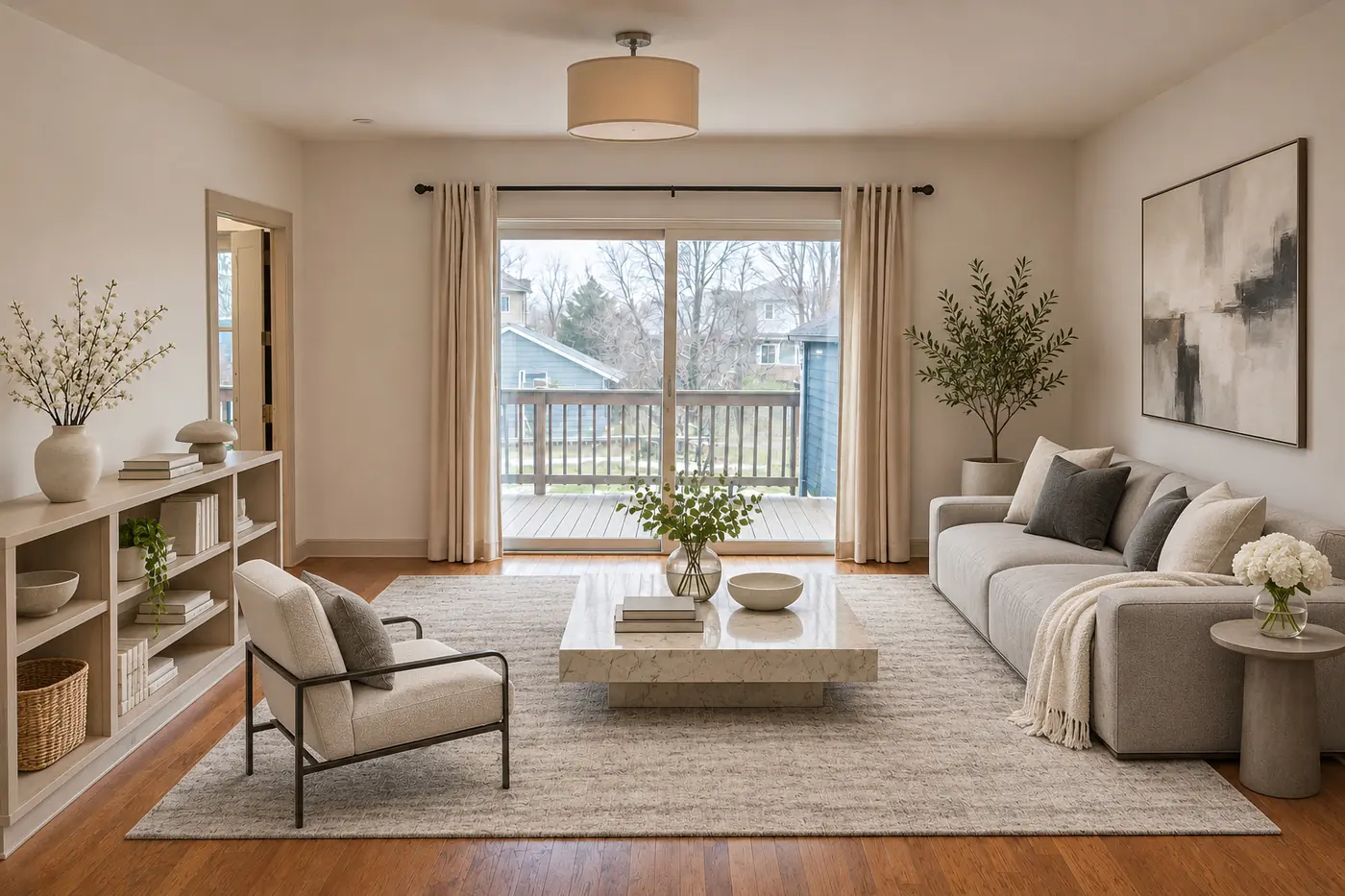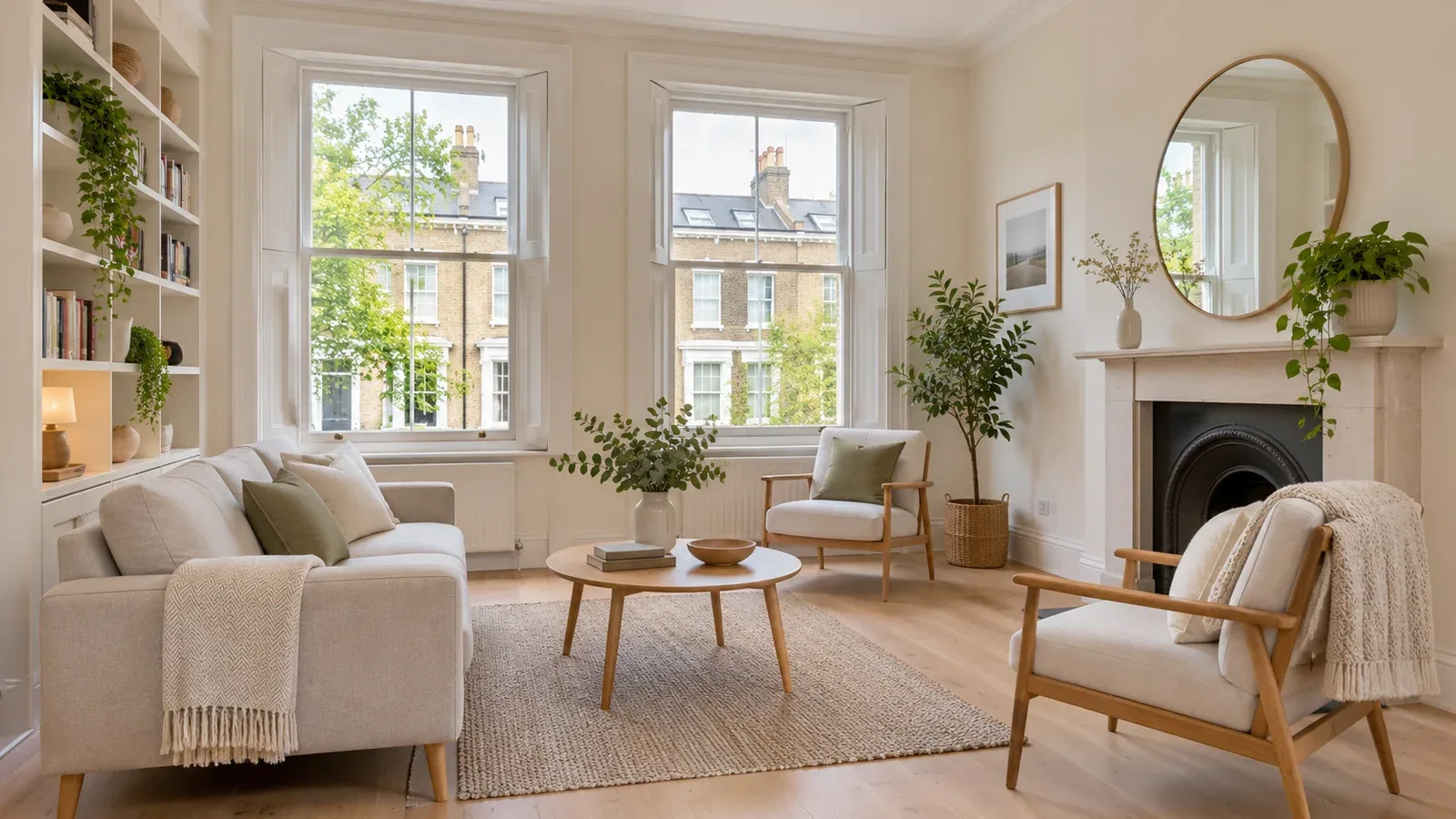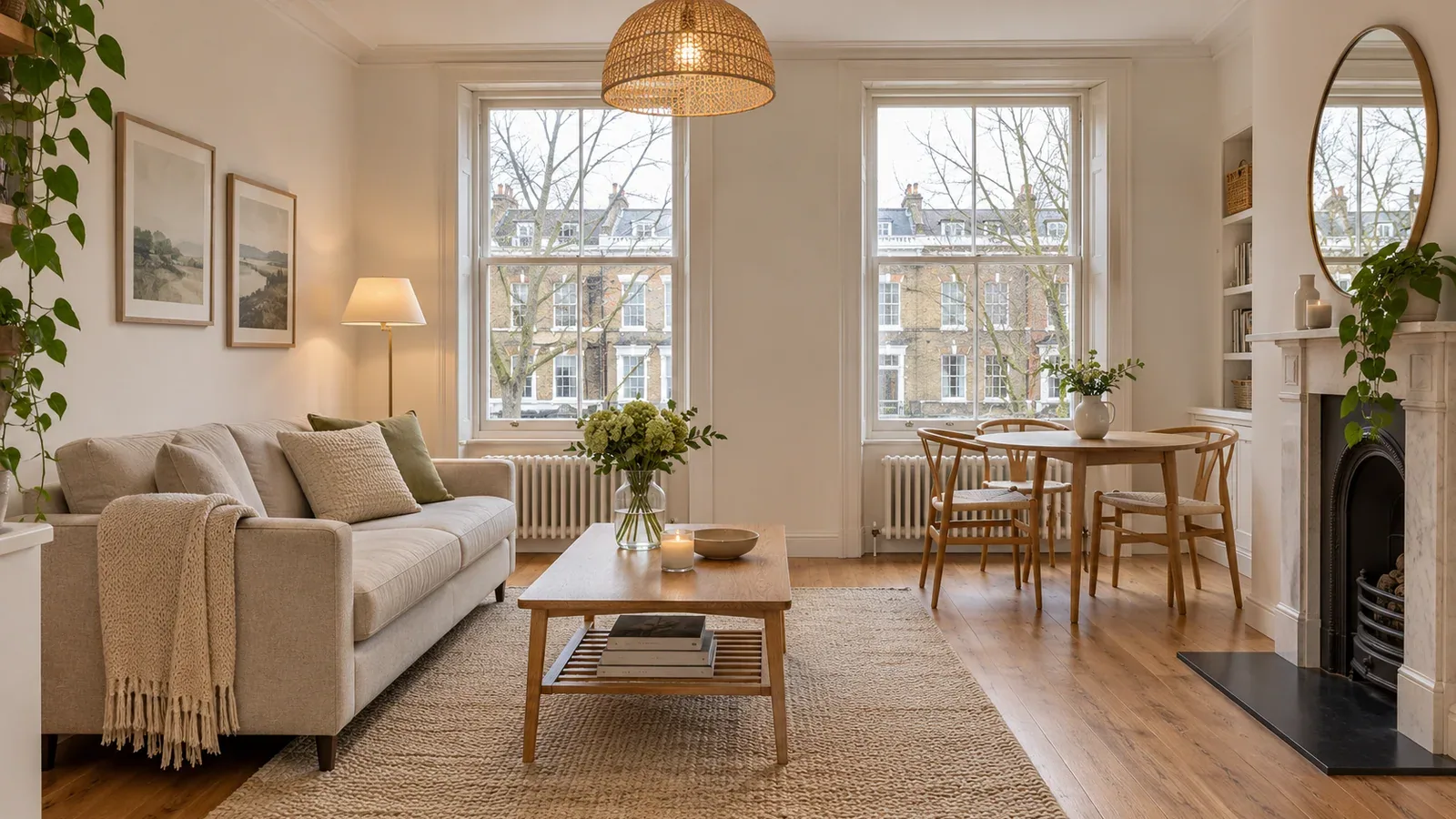
How much does virtual staging cost? For straightforward empty-room photographs, budget from a few pounds per image for self-service AI through to tens of pounds for an editor or managed service; bespoke work can cost more. The useful comparison is the total cost of a finished image you can confidently put in a listing, including furniture removal, revisions, tax and your own checking time.
This 2026 guide explains how the pricing models work, what to ask before ordering and how to keep a small property campaign within budget. The figures below are planning guidance rather than a market average or a quote for EstatePixelPro.
Virtual staging prices: what are you paying for?
Virtual staging adds digital furniture to a photograph. You are paying for an image, so two angles of the same bedroom may mean two separate charges. Physical staging also provides furniture for viewings, which makes it a different purchase. Our guide to virtual staging versus traditional staging explains that decision in more detail.
| Route | Price level to expect | What to confirm |
|---|---|---|
| Self-service AI | Often a few pounds per generated image, depending on the credit pack or plan | Credits per operation, unused allowance and repeat-generation charges |
| Freelance editor | From low-cost entry packages to tens of pounds per image; specialist work can be higher | Exactly what the starting package includes, revisions and marketplace fees |
| Managed staging service | Usually a quote in tens of pounds per image for standard work, with package options | Styling brief, furniture removal, delivery schedule and quality review |
| Bespoke or complex work | Individually quoted; potentially above standard staging rates | Furniture matching, awkward geometry and consistency between views |
Published prices illustrate the spread, but do not establish a universal rate. Fiverr's virtual staging listings show widely varying starting packages, often in US dollars. A starting package is not necessarily the price for your full photograph, requested resolution or revision brief.
For a UK service example, LTW's published pricing places standard staging and declutter-and-restage work in roughly the £30–£45 per-image band, with separate arrangements for bespoke furniture and image bundles. Treat this as one provider's scope and pricing, rather than a typical charge across Europe. Confirm current terms before ordering.
AI, freelancers or an agency: compare the whole job
A self-service tool suits an agent or photographer who can choose the source image, try a furnishing style and inspect the result. The invoice may be small, but someone still needs to check furniture scale, door access, shadows and architectural accuracy. A quick generation does not remove that responsibility.
A freelancer can be useful when you want to brief the person doing the work directly. Send the original photograph, explain the room's intended use and mark features that must remain. Ask whether the quoted service uses manual editing, AI or both, and request examples of comparable properties. A sample bedroom says little about a difficult open-plan room.
A managed service may handle briefing, review and coordination across several photographs. That can justify a higher fee when a developer needs a consistent visual scheme or a photographer has little time for correspondence. Establish who approves the work and how corrections are handled before the listing deadline.
EstatePixelPro offers self-service Virtual Staging with Modern, Scandinavian, Minimalist, Luxury, Warm wood and Indochine styles. One credit covers one tool on one photo; staging a room that needs decluttering uses one additional credit. Its credit packs are priced in USD and paid through PayPal, so UK and euro-area buyers should allow for the exchange rate and any applicable payment-provider charges.
Six things that change the final bill
- Furniture removal: an empty room and an occupied room are different briefs. Removing a sofa may require reconstructing the floor behind it before adding new furniture.
- Number of views: multiple angles increase the image count. Ask whether the same furniture layout can be maintained across those views.
- Specific styling: a general Scandinavian look is a simpler request than matching a named dining set or a developer's exact show-home specification.
- Revisions: establish whether a correction, a new layout and a complete style change are treated differently. With AI, check whether another attempt consumes credits.
- Delivery requirements: confirm turnaround, file dimensions and whether a deadline or print-ready version attracts an extra charge.
- Tax and administration: compare quotes on the same VAT basis. Include platform charges, currency conversion and the time spent preparing files and approving results.
The source photograph matters too. A tilted, dark image with clipped windows may need correction before staging is worthwhile. If the wider shoot includes dull exterior photographs, our grey-weather and sky-replacement checklist helps you decide which improvements belong in a separate editing brief.
Build a budget for a two-bedroom flat
Start with the question each image needs to answer. An empty living room may need a sofa and dining arrangement to explain its layout. A main bedroom may need a bed to show its intended use. A clear kitchen or bathroom often needs no added furniture at all.
Consider a hypothetical brief with three final images: one living-room view and one photograph of each bedroom. One bedroom contains furniture that must be removed. Get the provider to separate the price of three staging edits from the removal work, rather than assuming a three-image package includes both.
For an illustrative managed-service budget, suppose staging is quoted at £20–£40 per image and removal at £10–£20 for the affected photograph. That gives a planning range of £70–£140 before any applicable tax or other extras. These are example quote assumptions, not advertised EstatePixelPro rates or a promise of what a supplier will charge.
On EstatePixelPro, that same brief needs three staging credits plus one decluttering credit, provided each operation produces an acceptable result on the first attempt. Budget separately for any additional attempts or other tools you choose. The credit requirement and the cash you need to spend on a pack are different figures.
If a euro-area supplier quotes in euros, build the brief in euros from the outset. Avoid comparing a VAT-inclusive euro quote with a dollar headline price that excludes fees. Ask for the full payable amount in your purchasing currency wherever possible.
For a subscription elsewhere, divide the amount you actually pay by the number of approved images you use. An allowance that looks inexpensive when fully used may offer poor value in a quiet month. For photographers, include selection, upload, review and client delivery time in the job estimate.
When is virtual staging worth the cost?
It is most useful when furniture resolves a real ambiguity: where a dining table fits, how an open-plan space can be divided or whether a spare room could function as an office. A credible illustration can answer that question without furnishing the property physically.
Spend selectively when the existing photographs already explain the home well. Adding decorative furniture to every image can create unnecessary cost and inconsistent layouts. For a holiday let on Airbnb or Booking.com, photographs should clearly communicate what guests will actually receive; imagined furniture must never be presented as an included amenity.
Decide your success criteria before ordering. You might want fewer questions about a room's use, more consistent client approvals or a clearer image sequence. Enquiries also depend on asking price, location, condition and demand. Virtual staging cannot guarantee a faster sale or a higher selling price.
If you test staged photographs, record the dates and any simultaneous changes to price or advertising. Otherwise, a change in enquiry volume tells you little about which intervention helped. Keep the expense proportionate to the particular communication problem.
Approve accuracy, disclosure and the final scope
A low-cost image is wasted if it misrepresents the home. Before approving it, compare the edit against the original at full size. Windows, doors, sockets, radiators, built-in cupboards and structural features should remain accurate. Check that a bed or sofa has not been shrunk to make the room appear larger, and that circulation routes remain plausible.
Label virtual staging clearly, for example: “Virtually staged illustration; furniture is not present at the property.” Keep an unaltered photograph available alongside the illustration. Disclose digital decluttering and day-to-dusk treatments too. Check current portal requirements and applicable UK or EU consumer-protection rules; labelling does not make an inaccurate image acceptable.
Before placing the order, confirm the following:
- The final image count, including every additional angle.
- Which photographs require removal work before staging.
- The styling brief, protected features and acceptable revision process.
- Delivery dimensions, commercial usage permissions and final deadline.
- The full payable amount, tax treatment and any repeat-edit charges.
The right virtual staging budget buys enough accurate images to explain the property, with time allowed for review. Start with one useful room, approve it carefully, then extend the brief only where furniture adds clarity. To calculate a current self-service budget, check EstatePixelPro's credit packs against the number of staging and decluttering operations your photographs need.
Frequently asked questions
Is virtual staging charged per room or per photograph?
Many services charge per photograph, so two views of the same room can count as two edits. Ask whether a package covers images, rooms or an entire property, and whether matching furniture across views is included.
Is a virtual staging subscription worthwhile for occasional listings?
Compare the subscription payment with the number of approved images you realistically expect to use. Check unused-credit rules and cancellation terms; a pay-as-you-go option may suit irregular work better.
Do I need 4K virtual staging for a property listing?
Check the destination portal's current image guidance and your intended crop before ordering. Higher-resolution files may be useful for brochures or reuse, but cannot correct a blurred source photograph or inaccurate staging.
Can I use virtually staged photographs to advertise a holiday let?
Check the booking platform's current rules and ensure the listing accurately shows what guests will receive. Clearly disclose any illustrative furniture, and never suggest that digitally added items are included amenities.